The Debrief · Tactical Breakdowns
Why City’s left-back plays as a ten
On the teamsheet, Gvardiol and O’Reilly are left-backs. On the ball, you’ll find them where the number 10 lives.
Here’s my tactical breakdown.
Read the breakdown →Introduction
Inverting the full-back. It’s one of the main trends in football, and City are taking it to new levels this season. Their left-back keeps turning up as a ten.
On any teamsheet, Gvardiol and O’Reilly are listed as left-backs. On the ball, it’s a very different story. They’re often in the left half-space, which is normally where you’d find your number 10 or left-sided 8.
This isn’t a one-off from one game. It’s a pattern, it’s been there since the Community Shield, and both left-backs do it. So I want to go through it step by step: how they get there, what they do once they’re in, and why City bother.
Coming up:
01 · Step one
Inside the winger
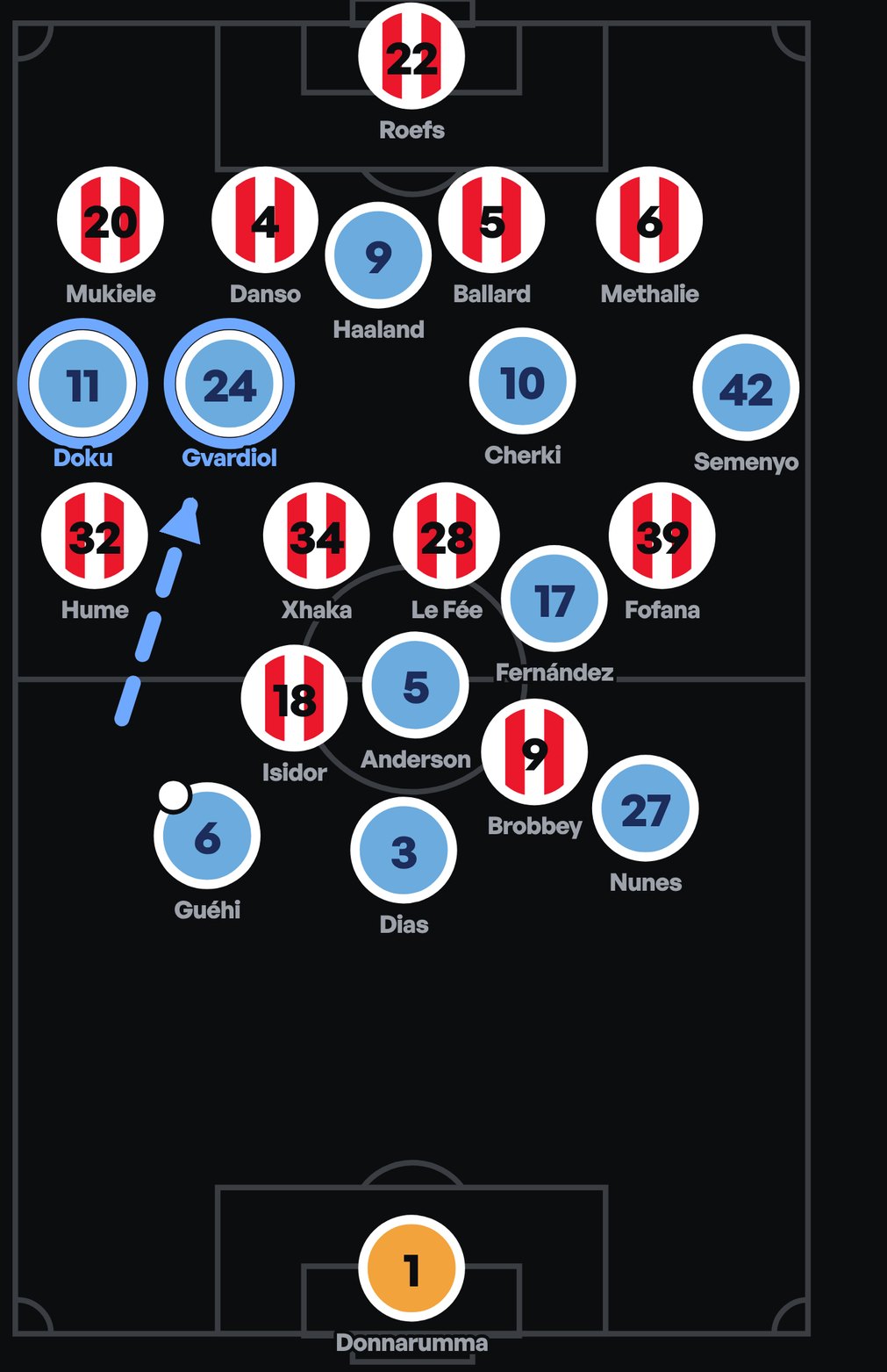
It all starts with the winger. Doku holds the touchline, as wide as he can get, and that’s what frees the left-back. With the width already taken, Gvardiol can leave his slot and step inside into the left half-space.
Behind him, City don’t leave the door open. Nunes, Dias and Guéhi become a back three, with Anderson sitting in front of them. Three and one. That’s the cover that protects against transitions, so if the ball goes, City still have four players between it and Donnarumma.
Now look at it from Sunderland’s side. Hume is their wide player on that side, and the man he’d normally pick up has just walked away from him. Does he follow Gvardiol inside and leave Doku? Or does he stay and guard a lane that’s now empty? Either way, he’s been asked a question before City have even played forward.
Watch for it
When City have the ball in their own half, look at the left touchline. If Doku is on the chalk, look inside him. That’s where the left-back is going.
02 · Step two
Break the midfield line
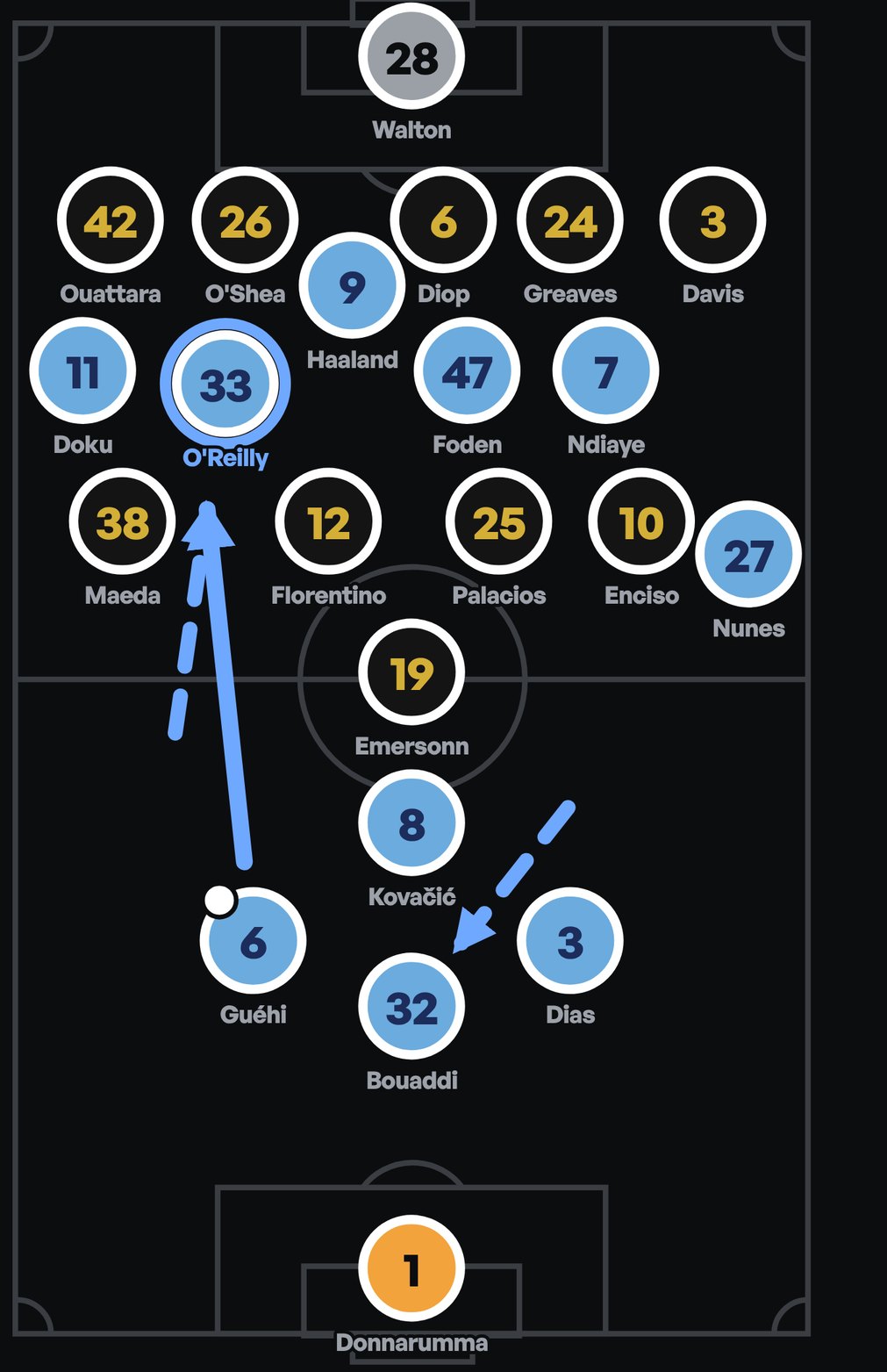
Once he’s inside, City need to find him. One pass through the opposition’s midfield and he’s between the lines. On the board it’s O’Reilly against Ipswich, with Bouaddi dropping in between Dias and Guéhi so the back line still has its numbers, and Guéhi playing through the gap between Maeda and Florentino.
Why there? Because a full-back receiving between the lines is receiving in a space the other team hasn’t planned to defend. Ipswich’s midfielders are facing the ball. Their back line is facing the ball. He’s arrived in the gap between both, often from their blind side.
If he gets a half-turn on his first touch, he’s facing forward with options. He can drive at the back line, or find Cherki and Haaland. That forces a decision from the back line: step out to him and leave space behind, or let him turn. Both are bad options.
Watch for it
Watch the centre-back on the ball. If he looks inside rather than down the line, the pass is going to the full-back between the lines, not the winger.
03 · Step three
Combine with the ten
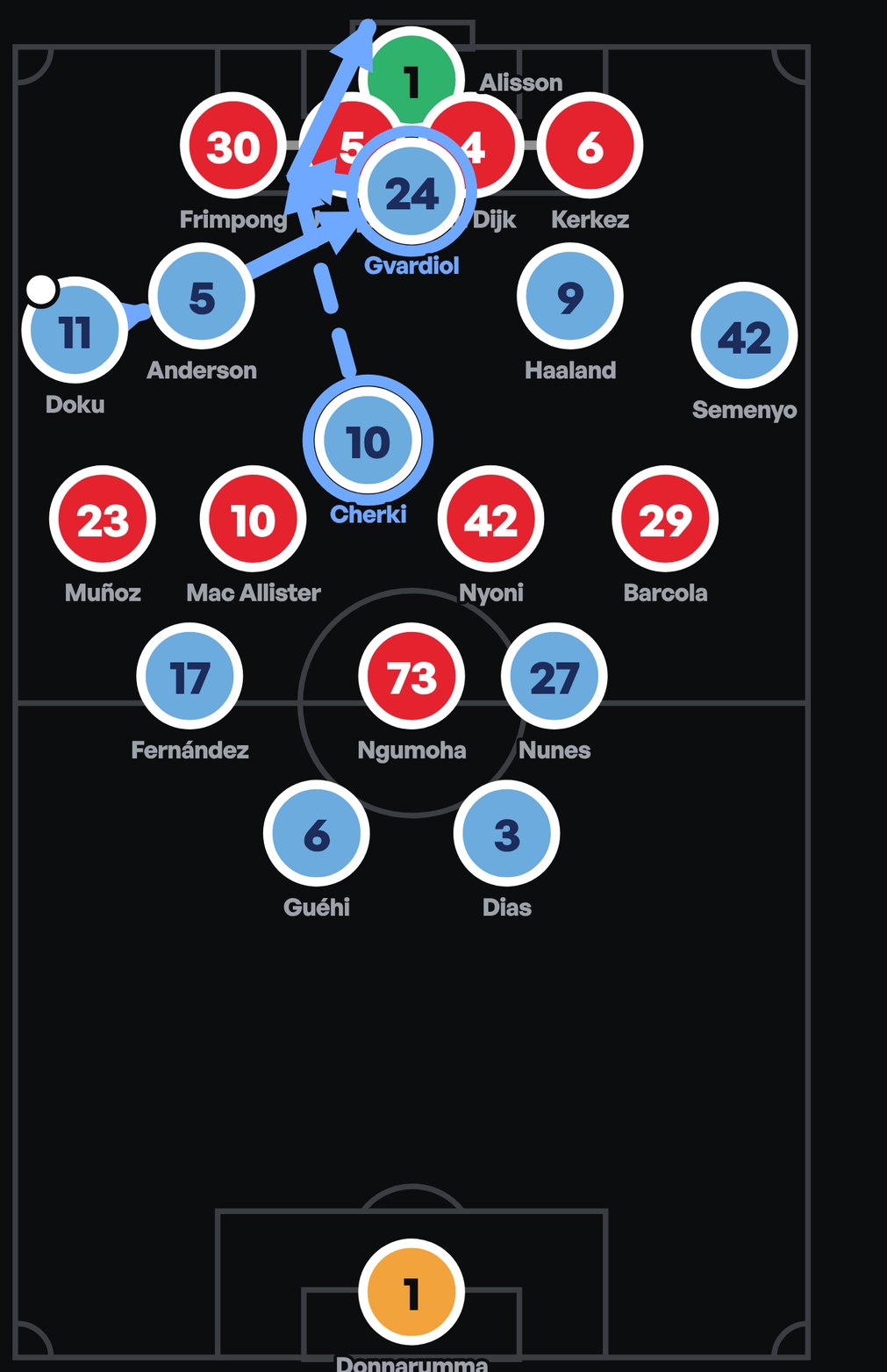
Once he’s in there, he’s another option for the winger and the ten. It overloads the left side. And because he’s not a full-back stuck on the line any more, he can play quick, first time, in tight areas.
Anfield is the best example. Gvardiol came on for O’Reilly in the 66th minute, and 12 minutes later he’s in the Liverpool box, inside Doku, and flicks it back first time into Cherki’s run. Goal.
That one touch is the whole point. A first-time lay-off beats whoever is marking him, because the defender is still reacting to where the ball was. By the time he’s turned, Cherki’s already arrived. And how many left-backs do you know who are comfortable doing that in the opposition box, with their back to goal?
Watch for it
When the left-back gets the ball near the box, don’t follow the ball. Watch the ten. If he’s already running, the lay-off is coming.
04 · Step four
Beyond the winger
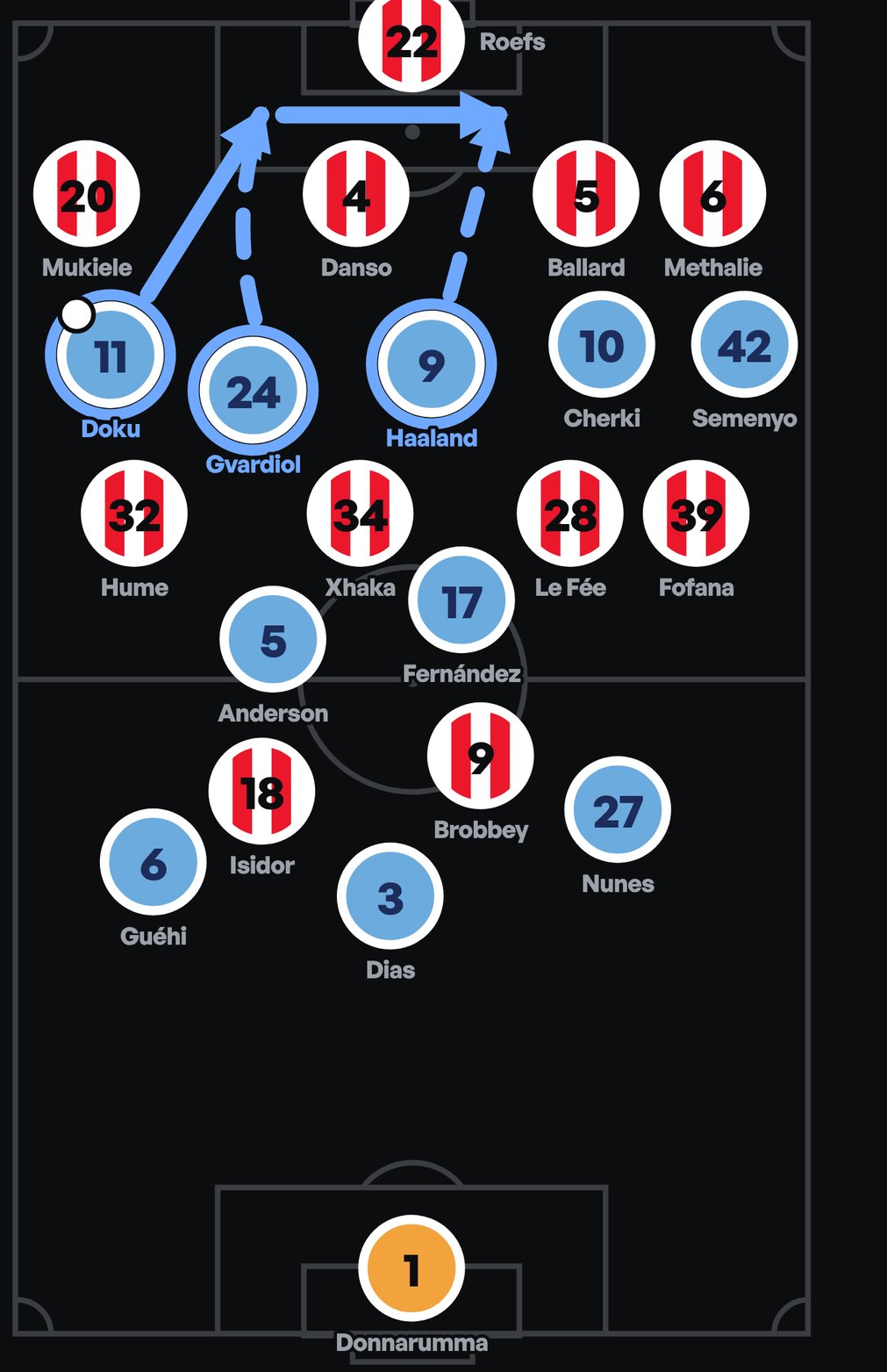
Crucially, they’re not static in that space. They run past the winger into the inside channel, and that’s a horrible run to track.
Whose man is he? The player responsible for tracking him is usually either a centre-back, but they’re occupied by Haaland (bit hard to ignore him), or a midfielder, and the job gets handed on depending on how they defend. That situation alone throws up some trouble. Hand him on late and he’s gone. Send someone with him and you open space into Haaland or the midfield.
The fifth goal against Sunderland is exactly this. Doku had come on at 75, he slides the ball in behind, and Gvardiol runs inside him onto it (flagged offside, VAR said onside). Low ball across the six-yard box, Haaland at the back post.
Watch for it
When the winger cuts inside with the ball, take your eyes off him for a second. If the left-back is already moving past him on the inside, that’s the pass.
05 · Why City do it
The extra man inside
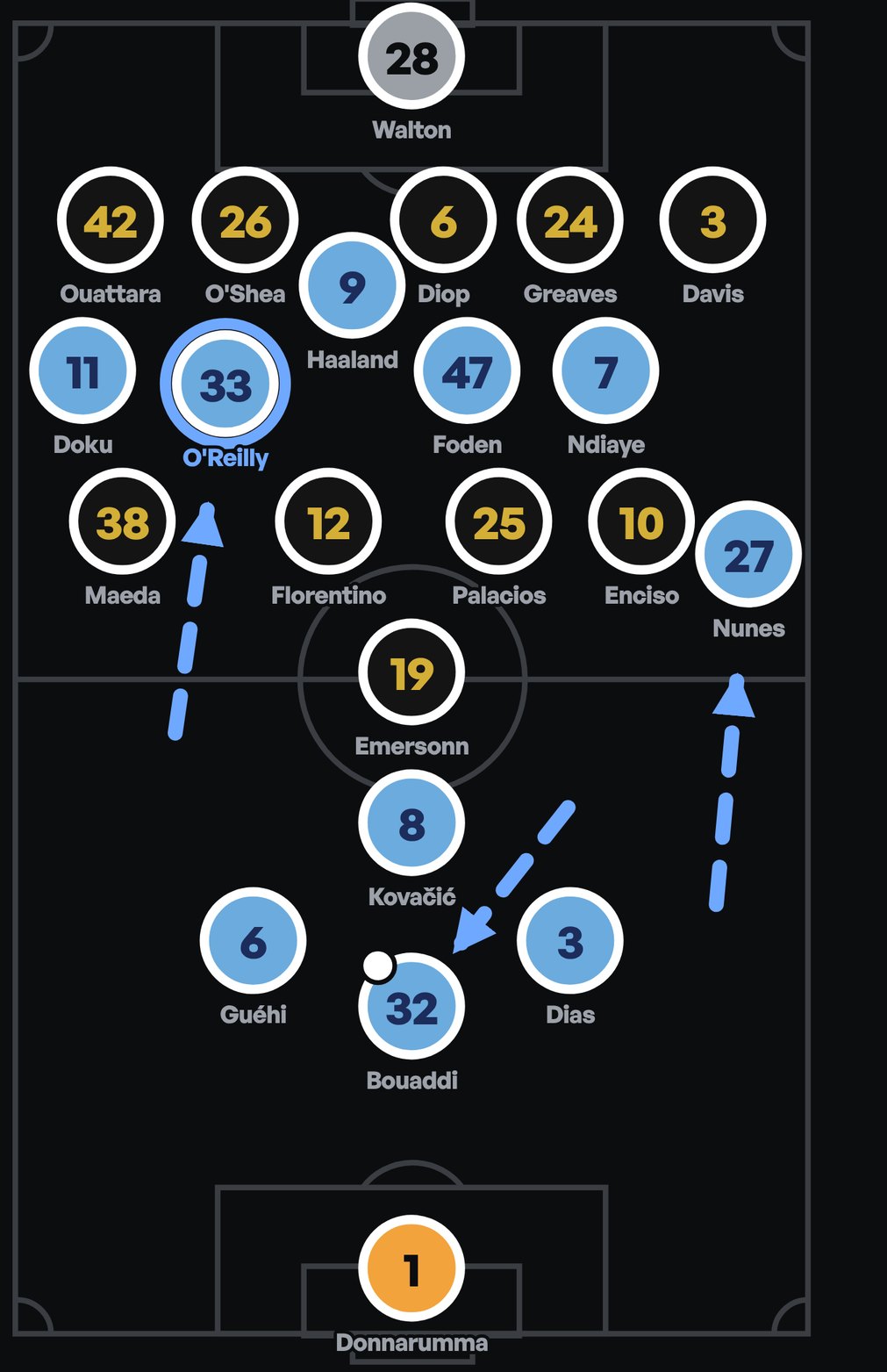
So why? It puts an extra man between the lines, pins the opposition’s wide midfielder and leaves the winger his one v one. It forces quick decisions and stops the opposition doubling up on Doku. If they do, it’s likely the left-back has some space to exploit.
And it only works because of what’s behind it. Against Ipswich, Bouaddi dropped in between Dias and Guéhi, which freed O’Reilly and Nunes to get forward. The cover never makes the highlights, but without it the full-backs can’t go anywhere.
You can see it all season. Gvardiol played the whole game at left-back against Bournemouth and won it in the 91st minute off Cherki’s through ball. O’Reilly did it at the Community Shield too, starting at left-back and moving into a left attacking-midfield role on the ball, where he’s extremely comfortable (City lost that one 3-0, so it’s not a magic button).
To be fair, it’s not the only way they hurt you from there. The winner at Old Trafford came from a Gvardiol cross from out wide. But that’s the point. A full-back who can do both is a nightmare to plan for.
Watch for it
Count City’s players behind the ball when they attack down the left. If it’s three and one, the left-back is free to go. If it’s two, he stays.
Final thoughts
Is the left-back the new ten?
The full-back role has probably evolved the most in recent seasons. Overlapping, then inverting into midfield, and now turning up as a ten and making runs into the box.
It’s also not just City. Calafiori scored for Arsenal 24 seconds into the Community Shield from an out-to-in run into that same channel.
Teams will find answers. Villa got tight to Doku early on Saturday and City lost their first league game of the season (I went through that one in my Villa breakdown). Take away the winger’s width and the left-back’s lane gets harder to find.
But is it now a minimum expectation that players play in as many different positions as possible, and look like a duck to water when they do it?
It feels like that’s where we’re heading, that’s if we’re not already there...
Do it yourself
What? How? Why?
Every section above follows the same three questions. Here’s the framework, so you can break a game down the same way.
Read the framework →More breakdowns
Tactical Breakdowns
Every tactical breakdown I do gets its full version here, with the boards in motion.
See all breakdowns →