THE DEBRIEF · 02
Debrief 02
What goes into a match report
The inverted full-back, how a report turns it into a finding, a free template to build your own, plus what I’ve been up to this week.
By Harry Lowe · 29 October 2026 · 7 min read
Read the article →
Introduction
Hey, legends 🤙🏼
Today, we're covering a behaviour that we have seen develop over recent seasons, which as a consequence has meant that full-backs have become on of the most important positions on the pitch.
We’ll start with why full-backs step inside, from the first pass out of defence all the way to the box. Then I’ll show you how an analyst would turn that kind of movement into a finding in a match report, using the same five parts I’d use myself. After that there’s a free template and a task, so you can have a go yourself. And at the end, what I’ve been up to this week.
01 · Tactical breakdown
Why full-backs step inside
Full-backs stepping inside has been one of the most consistent developments across recent seasons. What we are seeing this season is the inversion of the position being taken to some extreme lengths, in particular by teams like Man City and Arsenal. Inverting the full-back does a different job depending on where on the pitch it happens. Here it is from the first pass out of defence all the way into the final third.
- In the build-up
- When the centre-backs have the ball, the full-back leaves the touchline and stands next to the holding midfielder. The back two becomes a back three, and with the goalkeeper that can be six players against a front four, so there’s always a free pass. It also gives the centre-backs a pass through the middle of the press, into a player already facing forward.
- Freeing the winger
- With the full-back inside, the winger doesn’t have to come short for the ball. They can hold the touchline high and wide and pin the opposition full-back. If the opposition winger follows the full-back inside, the player out wide is free for the long pass.
- Between the lines
- Higher up, the full-back moves inside the winger into the half-space, while the centre-backs and a holding midfielder stay back as cover. One pass through the opposition’s midfield finds them between the lines, where they can turn, drive at the back line, or set the ten and the nine.
- Attacking the box
- The last step is the run. A full-back breaking into the inside channel is a really difficult run to track. The player nominally responsible is usually one of the other team’s attackers, and the job gets handed on depending on how they defend. That’s how a full-back ends up squaring for the striker at the back post, or arriving late to finish a through ball.
- Why teams do it
- An extra player in midfield against the press, an extra player between the lines, the opposition’s wide midfielder pinned, and the winger left with a one v one.
Three ways to stop it in the build-up
Option A · Hold the winger, step across
Our right winger holds position to block the pass wide, and our central midfielder steps across to the full-back as they come inside.
Risk: It leaves a gap in the middle that their number 8 could use.
Option B · Let them in, then trap
Let the full-back receive inside, then our winger presses from one side and our midfielder from the other.
Risk: The timing has to be spot on, because one good first touch beats both players.
Option C · Protect the switch
Our right-back stays tight to their winger, and our right centre-back covers the space inside.
Risk: It pulls our back line wider and can open the channel between the centre-backs.
For more detail, my Arsenal 2-0 Everton breakdown shows it in the build-up, and my carousel on why City’s left-back plays as a ten shows it higher up the pitch.
02 · Lesson
What goes into a match report
It's one of the most fundamental pieces of work an analyst produce. A match report is how an analyst gets the staff and players ready for the next opponent. It usually follows the same framework every week, so the staff always know where to find each part, they know exactly what they are looking for and every finding inside it is built to summarise and solve . It's designed to allow the analyst department and coaching team understand what problems they are likely to face against an opponent and propose ways in which these scenarios can be overcome. The best reports I have come across don't just propose a list of potential problems, but offer resolutions.
And most importantly, they explain the story very clearly.
What follows is an example of the kind of report you’d typically prepare for the coaching staff before a match. First, how a report is usually structured, section by section. Then how you set up the story inside each section, so every point is quick to take in and easy for a coach to pass on to the players.
- Overview
- Team shape
- In possession
- Out of possession
- Transitions
- Set pieces
- Key individuals
- Game plan and solutions
- 01
Description
What they do, in plain words, in two or three sentences.
- 02
Video
Telestrated clips that show it.
- 03
Data
How often it happens, and where. Evidence to support your claim.
- 04
Graphic
The mechanism drawn on a pitch, simple enough to explain to players in a meeting.
- 05
Solution
The options for our team. Each one comes with its risk, so the coaches can choose.
The five parts in action
So that’s the structure. Now here’s what one finding looks like once it’s filled in. I’ve taken the build-up movement from the breakdown above, a full-back stepping inside into midfield, and written it up the way it would go into a report for the coaching staff, one part at a time. The opponent is made up, but you’ll see this mechanism every weekend.
Read it as a model answer. Straight after it comes the free resource, where you build exactly this kind of page yourself, for a team and a match of your choice.
- Description
- When their centre-back has the ball, the left-back steps inside into midfield next to the number 6. If our right winger follows, their left winger is free for the long pass.
- Video
- Three clips: two where the left-back steps inside and the ball goes wide, and one where our midfielder steps across and the pass wide is blocked.
- Data
- The left-back stepped inside in 14 build-ups, against 4 for the right-back. So it’s a pattern, and it’s focused on one side.
- Graphic
- Two boards, the starting positions and then the movement and the pass, with only the players involved drawn.
- Solution
- Options A, B and C above, each with its risk. The coaches pick one, and the training week gets the players ready for it.
03 · Free resource and task
Build Your First Match Report
Build Your First Match Report is a free task in The Portal. It takes you through building one report finding on one team’s build-up, with the same five parts as above. The template is made for PowerPoint. It also opens in Keynote and Google Slides, though both change the fonts.
What’s inside- A one-page report template, with a place for every part of a finding
- Two pitch templates with player markers and arrows, for drawing the movement
- Six steps, from choosing one mechanism to offering two solutions
- A free practice dataset: a fictional match laid out like professional event data, with build-up patterns hidden in it
- A six-question check, to read your page the way a coach would
I want to help support analysts, by improving the output, quality and information inside of their outputs.
From my time working within elite environments, one of my crucial takeaways is that your information has to be clear, make sense and be consumed almost by glancing at the page.
Yet, you'll be amazed how often I find myself reading reports and scratching my head. That's never a good sign, because if I don't understand it, then I'm 99% sure a coach won't either. That's why I have put together some match report templates designed to help enhance your work and simplify your stories (I'm going to do a whole series on communication and how you should speak to your peers, let alone world leading coaches, but we'll get on to that soon).
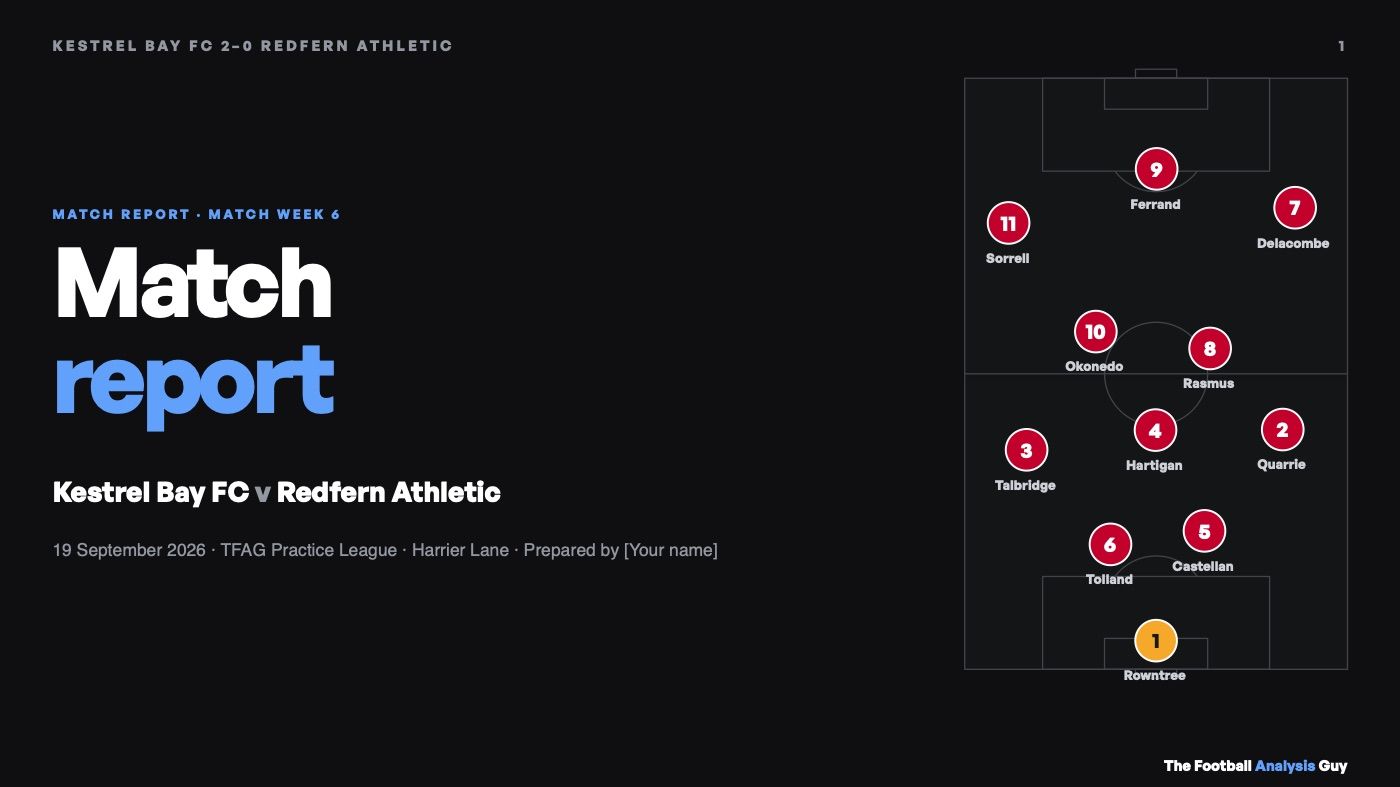
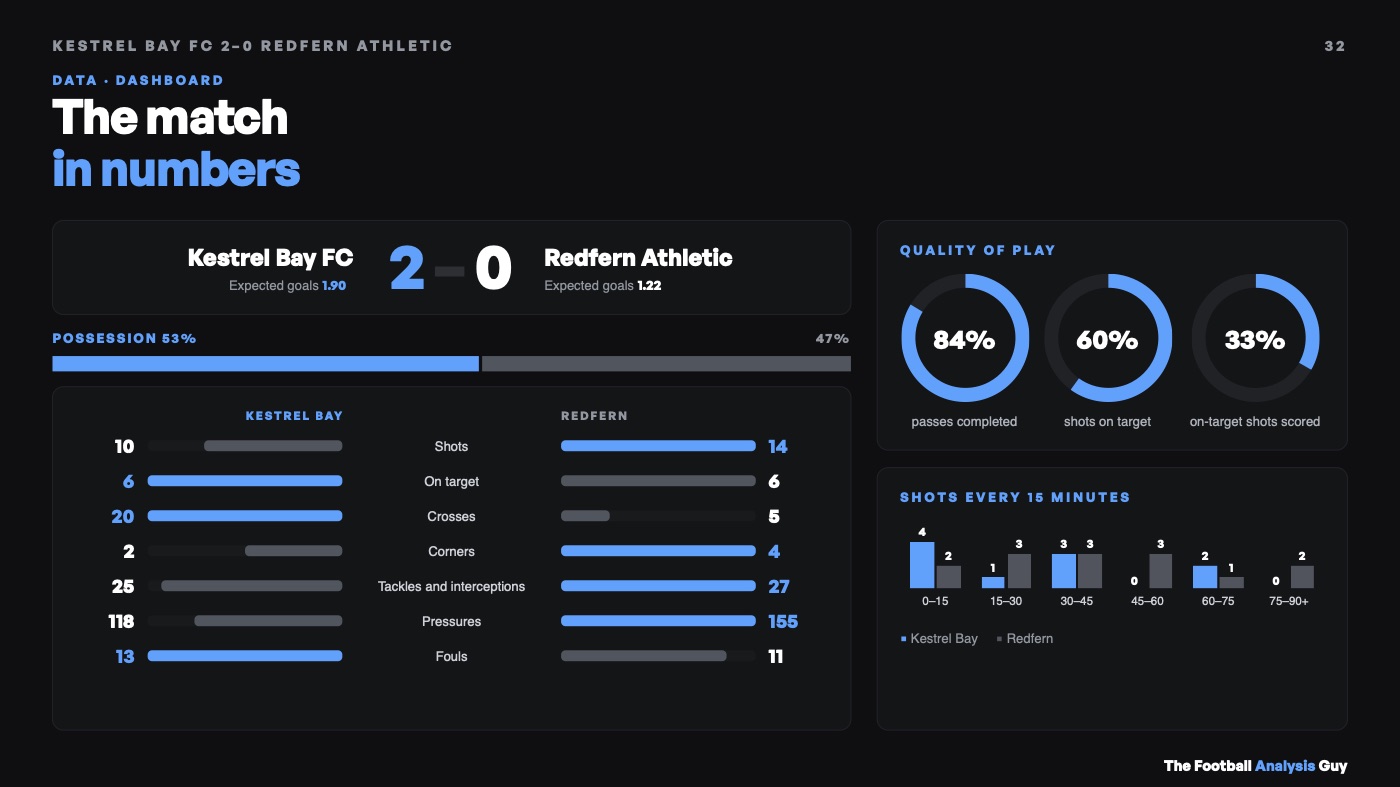
If you want them, they're below. I hope they help. In fact, I know they will.
Match Report Lite and Match Report Master are in The Tools, with templates for PowerPoint and Keynote ready to fill in.
04
My week


Cheers,
Harry
THE DEBRIEF · 02
Debrief 02
What goes into a match report
The inverted full-back, how a report turns it into a finding, a free template to build your own, plus what I’ve been up to this week.
By Harry Lowe · 29 October 2026 · 7 min read
Read the article →Introduction
Hey, legends 🤙🏼
Today, we're covering a behaviour that we have seen develop over recent seasons, which as a consequence has meant that full-backs have become on of the most important positions on the pitch.
We’ll start with why full-backs step inside, from the first pass out of defence all the way to the box. Then I’ll show you how an analyst would turn that kind of movement into a finding in a match report, using the same five parts I’d use myself. After that there’s a free template and a task, so you can have a go yourself. And at the end, what I’ve been up to this week.
01 · Tactical breakdown
Why full-backs step inside
Full-backs stepping inside has been one of the most consistent developments across recent seasons. What we are seeing this season is the inversion of the position being taken to some extreme lengths, in particular by teams like Man City and Arsenal. Inverting the full-back does a different job depending on where on the pitch it happens. Here it is from the first pass out of defence all the way into the final third.
- In the build-up
- When the centre-backs have the ball, the full-back leaves the touchline and stands next to the holding midfielder. The back two becomes a back three, and with the goalkeeper that can be six players against a front four, so there’s always a free pass. It also gives the centre-backs a pass through the middle of the press, into a player already facing forward.
- Freeing the winger
- With the full-back inside, the winger doesn’t have to come short for the ball. They can hold the touchline high and wide and pin the opposition full-back. If the opposition winger follows the full-back inside, the player out wide is free for the long pass.
- Between the lines
- Higher up, the full-back moves inside the winger into the half-space, while the centre-backs and a holding midfielder stay back as cover. One pass through the opposition’s midfield finds them between the lines, where they can turn, drive at the back line, or set the ten and the nine.
- Attacking the box
- The last step is the run. A full-back breaking into the inside channel is a really difficult run to track. The player nominally responsible is usually one of the other team’s attackers, and the job gets handed on depending on how they defend. That’s how a full-back ends up squaring for the striker at the back post, or arriving late to finish a through ball.
- Why teams do it
- An extra player in midfield against the press, an extra player between the lines, the opposition’s wide midfielder pinned, and the winger left with a one v one.
Three ways to stop it in the build-up
Option A · Hold the winger, step across
Our right winger holds position to block the pass wide, and our central midfielder steps across to the full-back as they come inside.
Risk: It leaves a gap in the middle that their number 8 could use.
Option B · Let them in, then trap
Let the full-back receive inside, then our winger presses from one side and our midfielder from the other.
Risk: The timing has to be spot on, because one good first touch beats both players.
Option C · Protect the switch
Our right-back stays tight to their winger, and our right centre-back covers the space inside.
Risk: It pulls our back line wider and can open the channel between the centre-backs.
For more detail, my Arsenal 2-0 Everton breakdown shows it in the build-up, and my carousel on why City’s left-back plays as a ten shows it higher up the pitch.
02 · Lesson
What goes into a match report
It's one of the most fundamental pieces of work an analyst produce. A match report is how an analyst gets the staff and players ready for the next opponent. It usually follows the same framework every week, so the staff always know where to find each part, they know exactly what they are looking for and every finding inside it is built to summarise and solve . It's designed to allow the analyst department and coaching team understand what problems they are likely to face against an opponent and propose ways in which these scenarios can be overcome. The best reports I have come across don't just propose a list of potential problems, but offer resolutions.
And most importantly, they explain the story very clearly.
What follows is an example of the kind of report you’d typically prepare for the coaching staff before a match. First, how a report is usually structured, section by section. Then how you set up the story inside each section, so every point is quick to take in and easy for a coach to pass on to the players.
- Overview
- Team shape
- In possession
- Out of possession
- Transitions
- Set pieces
- Key individuals
- Game plan and solutions
- 01
Description
What they do, in plain words, in two or three sentences.
- 02
Video
Telestrated clips that show it.
- 03
Data
How often it happens, and where. Evidence to support your claim.
- 04
Graphic
The mechanism drawn on a pitch, simple enough to explain to players in a meeting.
- 05
Solution
The options for our team. Each one comes with its risk, so the coaches can choose.
The five parts in action
So that’s the structure. Now here’s what one finding looks like once it’s filled in. I’ve taken the build-up movement from the breakdown above, a full-back stepping inside into midfield, and written it up the way it would go into a report for the coaching staff, one part at a time. The opponent is made up, but you’ll see this mechanism every weekend.
Read it as a model answer. Straight after it comes the free resource, where you build exactly this kind of page yourself, for a team and a match of your choice.
- Description
- When their centre-back has the ball, the left-back steps inside into midfield next to the number 6. If our right winger follows, their left winger is free for the long pass.
- Video
- Three clips: two where the left-back steps inside and the ball goes wide, and one where our midfielder steps across and the pass wide is blocked.
- Data
- The left-back stepped inside in 14 build-ups, against 4 for the right-back. So it’s a pattern, and it’s focused on one side.
- Graphic
- Two boards, the starting positions and then the movement and the pass, with only the players involved drawn.
- Solution
- Options A, B and C above, each with its risk. The coaches pick one, and the training week gets the players ready for it.
03 · Free resource and task
Build Your First Match Report
Build Your First Match Report is a free task in The Portal. It takes you through building one report finding on one team’s build-up, with the same five parts as above. The template is made for PowerPoint. It also opens in Keynote and Google Slides, though both change the fonts.
What’s inside- A one-page report template, with a place for every part of a finding
- Two pitch templates with player markers and arrows, for drawing the movement
- Six steps, from choosing one mechanism to offering two solutions
- A free practice dataset: a fictional match laid out like professional event data, with build-up patterns hidden in it
- A six-question check, to read your page the way a coach would
I want to help support analysts, by improving the output, quality and information inside of their outputs.
From my time working within elite environments, one of my crucial takeaways is that your information has to be clear, make sense and be consumed almost by glancing at the page.
Yet, you'll be amazed how often I find myself reading reports and scratching my head. That's never a good sign, because if I don't understand it, then I'm 99% sure a coach won't either. That's why I have put together some match report templates designed to help enhance your work and simplify your stories (I'm going to do a whole series on communication and how you should speak to your peers, let alone world leading coaches, but we'll get on to that soon).
If you want them, they're below. I hope they help. In fact, I know they will.
Match Report Lite and Match Report Master are in The Tools, with templates for PowerPoint and Keynote ready to fill in.
04
My week
Cheers,
Harry